How to Recognize Financial Self Sabotage Patterns
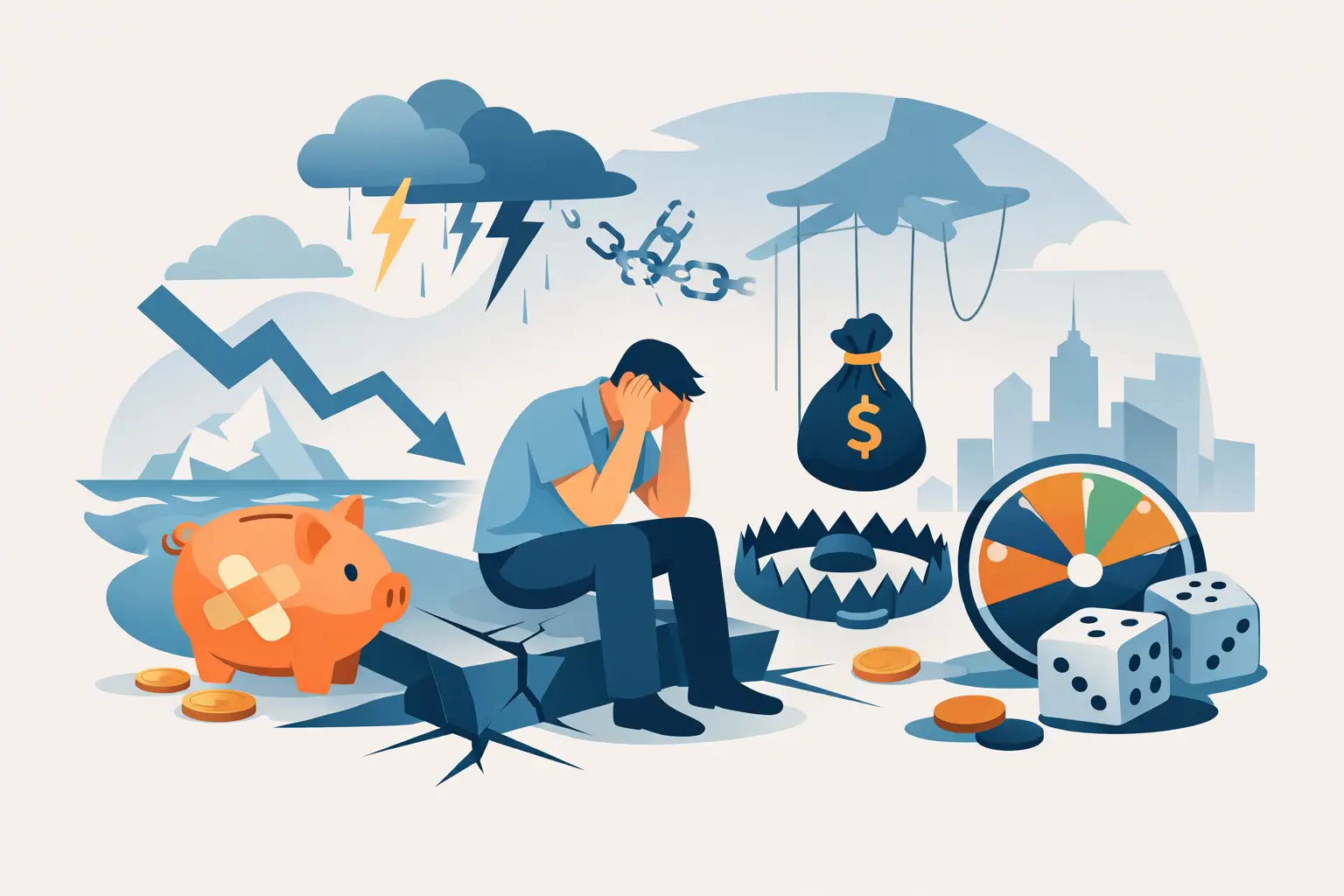
A raise arrives, and within weeks the extra money has quietly disappeared. You promise yourself you will check your account balance, then avoid opening the banking app for days. You know what would help, yet somehow repeat the opposite behavior. Learning how to recognize financial self sabotage begins here: not with judgment, but with curiosity about the gap between what you intend to do and what you actually do.
Financial self-sabotage is rarely about being irresponsible, lazy, or bad with money. More often, it is a protective pattern that once made emotional sense. Spending may bring relief after a difficult day. Avoidance may shield you from anxiety. Overworking may create a feeling of safety. The problem is not that these responses exist. The problem is when they quietly take control of choices that matter to your future.
What Financial Self-Sabotage Really Looks Like
Self-sabotage is any repeated money behavior that works against a goal you genuinely care about. It is not the occasional restaurant meal, an unexpected expense, or a season when saving is difficult. Real life requires flexibility, and a healthy financial life has room for enjoyment, generosity, and imperfection.
The distinction is repetition and cost. A pattern may be self-sabotaging when it leaves you feeling temporarily better but consistently less secure, less free, or less aligned with your values afterward. You may tell yourself, “Next month will be different,” while the same sequence plays out again.
This is why spreadsheets alone often fail to solve the problem. A budget can show where money went. It cannot, by itself, explain what the purchase, avoidance, or over-control was trying to do for you emotionally.
How to Recognize Financial Self Sabotage in Your Patterns
The clearest clues are not always found in a single transaction. They appear in the stories, emotions, and rituals that surround your decisions.
You avoid information that would give you clarity
Perhaps you leave bills unopened, delay checking your credit card balance, or put off reviewing retirement contributions because the numbers feel overwhelming. This can look like procrastination, but it is often anxiety in disguise.
Avoidance offers immediate relief. For a few hours or days, you do not have to face uncertainty, regret, or a decision you have been postponing. Yet the cost is that uncertainty grows in the background. Fees accumulate, deadlines pass, and the imagined problem becomes larger than the actual one may have been.
A useful question is: What do I fear the numbers will say about me? If the answer includes words like careless, behind, incapable, or failing, you have found a money story worth examining. Numbers are information. They are not a character verdict.
You use spending to change your emotional state
Emotional spending is not limited to dramatic shopping sprees. It can be the small, frequent purchases that happen whenever you feel bored, stressed, lonely, underappreciated, or exhausted. The purchase may be practical on the surface, but the timing tells a deeper story.
Ask what happened in the hour before you spent. Were you disappointed after a meeting? Scrolling after midnight? Trying to reward yourself for getting through a hard week? The goal is not to shame the purchase. It is to identify the need underneath it.
Sometimes the need is comfort. Sometimes it is novelty, recognition, rest, or a sense of control. Money cannot reliably meet all of those needs, but naming them gives you more choices than simply repeating the transaction.
You swing between restriction and rebellion
Some people sabotage their progress through spending. Others do it through extreme control. You may create a strict plan after feeling guilty, deny yourself anything enjoyable, and then eventually rebel against the pressure with a large purchase or a period of unchecked spending.
This cycle is common because deprivation can make money feel like a constant test of willpower. The more rigidly you frame every choice as good or bad, the harder it becomes to make steady, sustainable decisions.
A workable financial plan includes room for pleasure on purpose. That does not mean spending without limits. It means recognizing that a plan you resent is unlikely to become a lasting practice.
You make urgent choices to escape discomfort
Financial self-sabotage can also show up in career decisions. You may accept a low offer because negotiating feels uncomfortable, quit a job without preparing because you are desperate to leave, or stay in an underpaying role because asking for more feels selfish.
There are times when leaving quickly is necessary, and not every decision needs to be optimized. But if you repeatedly trade long-term stability for immediate emotional relief, pause and look for the pattern. Are you responding to the facts of the situation, or to an old belief that says conflict is dangerous, security is scarce, or you are asking for too much?
You cannot let yourself make progress feel real
This pattern is subtler. You pay down debt, build savings, or receive a bonus, then soon create a new financial crisis. You might lend money you cannot afford to lose, upgrade your lifestyle before the income is stable, or take on expenses that erase your margin.
For some people, stability feels unfamiliar enough to be uncomfortable. If your earlier experiences taught you that money disappears, that success attracts criticism, or that you must prove your worth through sacrifice, financial progress can trigger unease rather than relief.
The thought may not be conscious. It may sound like, “I deserve this,” “It will work out somehow,” or “There is no point planning because something always happens.” These statements are not just opinions. They can be scripts that shape your choices.
Find the Trigger, the Behavior, and the Payoff
A simple way to understand a repeating pattern is to map three parts: the trigger, the behavior, and the short-term payoff.
The trigger may be an emotion, a conflict, a social situation, or even a particular time of day. The behavior is what you do next: spend, avoid, overwork, give too much away, or make a rushed decision. The payoff is the temporary feeling you receive, such as relief, belonging, control, or escape.
For example, someone who feels behind compared with friends may book an expensive trip they cannot comfortably afford. The trigger is comparison. The behavior is overspending. The payoff is belonging and a brief escape from feeling left out. Seeing that sequence does not make the decision painless, but it makes it understandable. And what is understandable can be changed.
Try recording this pattern after a meaningful money decision for two weeks. Keep it brief. Write what happened, what you felt, what you did, and what you hoped the decision would give you. You are not building a case against yourself. You are gathering evidence about your financial identity.
Your Financial Archetype May Shape the Pattern
People do not sabotage their finances in identical ways because they do not carry identical money stories. One person may seek safety through constant saving and struggle to invest in their own growth. Another may seek freedom through spontaneity and feel trapped by structure. A third may tie self-worth to achievement and exhaust themselves chasing the next income milestone.
These are not fixed labels. They are patterns of protection. An archetype framework can help you see the motive beneath a habit, rather than reducing the habit to a flaw. At The Money Story, this perspective matters because lasting financial change starts when you understand the role money has been playing in your life.
Once you identify that role, you can choose a response that fits. The person who avoids balances may need a five-minute weekly money check-in, not a complicated system. The person who overspends after stressful days may need a pause between the feeling and the purchase, plus a reliable form of recovery that does not involve a checkout screen. The person who never spends may need to practice planned enjoyment without guilt.
Replace Shame With a Smaller Next Step
Insight matters, but insight without a new action can become another form of avoidance. Choose one pattern that has the greatest impact on your sense of stability, then make the next step small enough that your nervous system does not reject it.
If you avoid your accounts, set a timer and look at one balance. If online shopping is your pressure release, wait 24 hours before nonessential purchases over a dollar amount you choose. If you chronically underprice your work, prepare one sentence you can use when discussing compensation. The action should be specific, repeatable, and compassionate.
You may still feel resistance. That does not mean the step is wrong. It means you are doing something different from a familiar pattern. Progress is less about forcing perfection and more about proving, one decision at a time, that you can remain present with money without abandoning yourself.
Your money habits are not random, and they are not your identity. They are messages from a story that can be read with honesty, revised with care, and gradually replaced by choices that make your future feel more like your own.