Why Does Money Cause Anxiety? The Story Beneath
A bill arrives, your account balance dips, or a friend mentions a promotion. Within seconds, your body may react before your mind has formed a clear thought: a tight chest, a rush of dread, an urge to check your bank app again. Why does money cause anxiety so quickly and so personally?
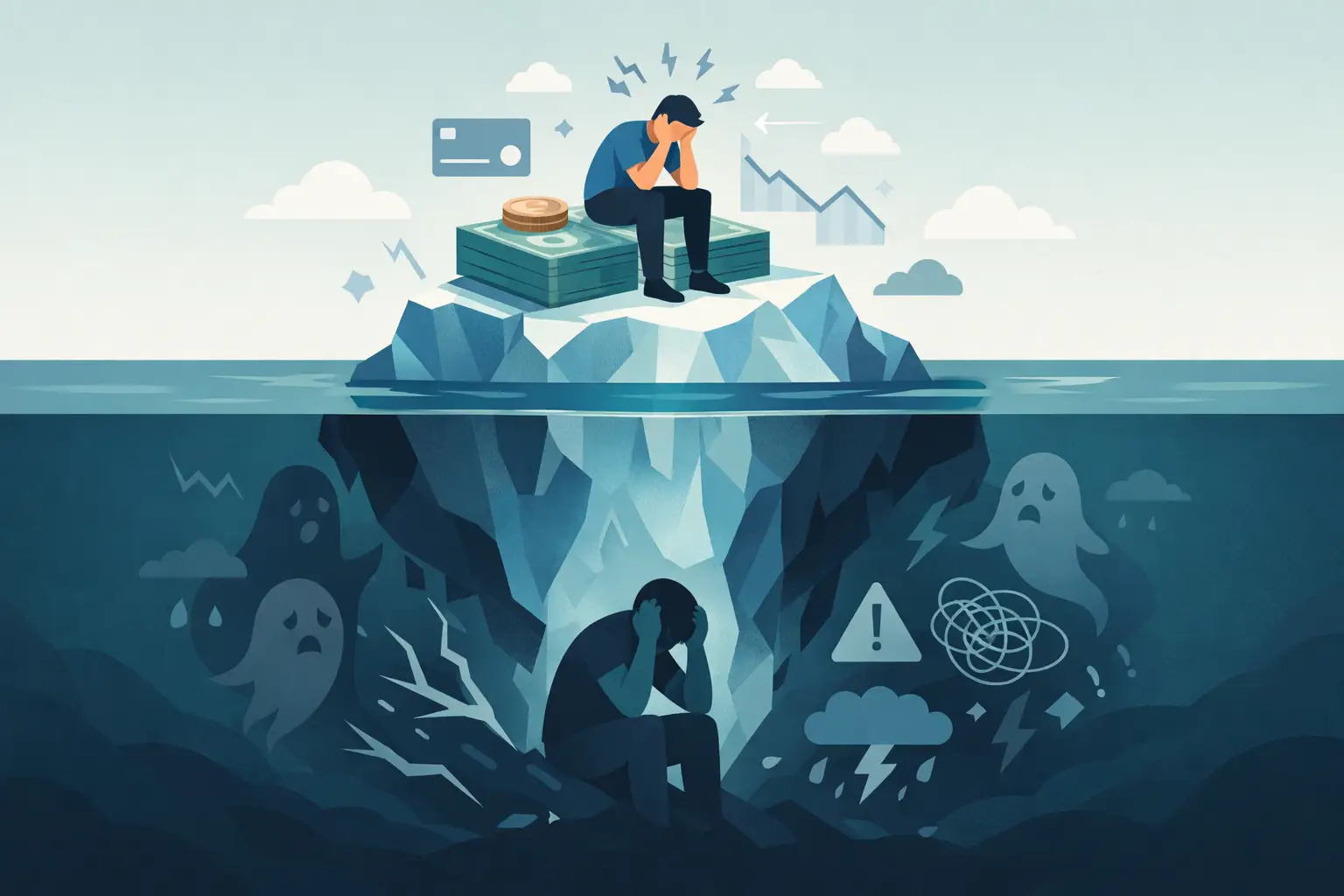
Because money is rarely just money. It is safety, freedom, approval, status, possibility, and, for many people, a measure of whether they are doing life “correctly.” A spreadsheet can show the numbers, but it cannot explain why someone with a healthy income still feels behind, or why another person avoids opening an account statement altogether. To understand financial anxiety, you have to look at the story beneath the transaction.
Why Does Money Cause Anxiety Even When Things Are “Fine”?
Financial anxiety is not always a direct reflection of financial danger. Certainly, inadequate income, debt, rising costs, and unpredictable expenses can create real pressure. Anxiety in those circumstances is not irrational. It is a human response to uncertainty and a lack of control.
But anxiety can persist even when the objective facts appear manageable. You may have savings, a stable job, and no immediate crisis, yet still feel one purchase away from disaster. That disconnect often signals that your relationship with money has been shaped by more than your current balance.
Money activates the parts of us that seek security and belonging. When it feels uncertain, the nervous system may interpret that uncertainty as a threat. The result is not always careful planning. It can be avoidance, compulsive checking, overworking, impulsive spending, or an inability to enjoy what you have earned.
The brain prefers certainty, and money rarely provides it
Money decisions are full of unknowns. Will your job remain stable? Will a medical expense appear? Are you saving enough for retirement? Did you make the right investment decision? Even people who plan carefully cannot eliminate every variable.
For a mind that equates certainty with safety, this open-endedness is exhausting. The goal then becomes impossible: to finally reach a number that guarantees nothing will go wrong. Since no number can fully provide that guarantee, the anxiety keeps moving the finish line.
This is why more income can help without automatically healing financial stress. It may reduce a practical problem while leaving the underlying fear untouched.
Your Money Story Shapes Your Stress Response
Every person develops a money story: a set of beliefs, memories, emotions, and unspoken rules absorbed over time. Perhaps money was discussed with tension in your family. Maybe it was never discussed at all. You may have watched a parent work constantly, witnessed financial instability, or learned that spending was the only visible form of celebration.
Those early experiences can become internal rules such as:
- “I have to earn rest.”
- “There is never enough.”
- “If I make a mistake, everything will fall apart.”
- “Money changes people.”
- “My value depends on how successful I look.”
These beliefs are often powerful precisely because they do not feel like beliefs. They feel like facts.
A person who learned that money disappears quickly may save aggressively but remain unable to feel secure. Someone raised around conflict about spending may avoid financial conversations with a partner, even when silence creates bigger problems. Someone who associates generosity with love may overgive, then feel anxious and resentful afterward.
The pattern is not a character flaw. It is an adaptation. At some point, it may have helped you make sense of your environment or protect yourself emotionally. The challenge is that an old adaptation can keep directing present-day choices long after the original conditions have changed.
Financial Anxiety Often Has an Identity Component
Money can feel deeply exposing because it appears to offer evidence about who we are. A missed savings goal can become “I am irresponsible.” Credit card debt can become “I have failed.” A colleague’s new home can become “I am behind.”
This is where comparison intensifies anxiety. Social media, professional circles, and family expectations can create a distorted sense of what everyone else has figured out. You see the visible outcomes: vacations, homes, promotions, purchases. You do not see the trade-offs, obligations, inheritances, fears, or private conflicts behind them.
When money becomes a scoreboard for worthiness, ordinary decisions become emotionally loaded. Buying lunch is no longer just buying lunch. It is proof that you lack discipline. Declining an invitation is no longer a choice. It is evidence that you cannot keep up. A market decline is no longer market movement. It is a verdict on your competence.
A healthier relationship with money begins when you separate your financial circumstances from your identity. Your money habits may need attention. Your numbers may require a plan. Neither makes you less capable of change or less worthy of respect.
Different Patterns Create Different Kinds of Anxiety
Generic advice often assumes everyone needs the same solution: spend less, save more, follow the plan. Those actions can matter, but they do not address the fact that people experience money through different emotional patterns.
One person may feel anxious because they seek control. They track every dollar, hesitate over small purchases, and struggle to delegate financial decisions. Their growth edge may be learning that planning is useful, but perfection is not protection.
Another may cope through avoidance. They delay bills, ignore account balances, and tell themselves they will deal with it later. For them, more detailed budgeting may feel overwhelming at first. The more useful starting point is a small, repeatable moment of contact with reality, free from shame.
Someone else may use spending to regulate emotion. A purchase offers temporary relief, reward, or reinvention, followed by guilt. The answer is not simply removing all pleasure from their budget. It is getting curious about what the purchase was trying to provide: comfort, recognition, relief, or a sense of control.
This is the value of an archetype-based lens. It does not label you as good or bad with money. It helps identify the protective strategy you tend to use, the fear beneath it, and the practical behavior that can create a different outcome. The Money Story begins with that kind of self-awareness because lasting change is more likely when the strategy fits the person.
How to Reduce Anxiety Without Pretending It Away
You do not need to think positively about money to feel better. You need a relationship with your financial reality that is clear enough to support action and compassionate enough to sustain it.
Start by naming the specific moment anxiety appears. Is it when you spend? When you receive money? When you look at debt? When someone asks about your career? Specificity turns a vague cloud of fear into something you can observe.
Then ask two questions: What am I afraid this means? And where did I learn that meaning? The first question reveals the threat. The second creates distance between your current self and an inherited rule.
Next, choose one stabilizing practice that matches the pattern. If avoidance is your tendency, set a 15-minute weekly money appointment with one simple purpose: review balances, upcoming bills, and one next step. If overcontrol is your pattern, set a defined amount for enjoyment and practice spending it without reopening the decision. If comparison drives your anxiety, reduce the inputs that trigger it and define progress using measures that belong to you.
It also helps to distinguish between a financial problem and an anxiety problem. Sometimes you need a concrete solution: increase income, negotiate a bill, build an emergency fund, or create a debt repayment plan. Sometimes the numbers are workable, but your body remains on high alert. Often, both are true. Addressing only the emotional side can leave a practical issue unresolved, while addressing only the numbers can leave the fear in charge.
Make Room for a New Story
The most useful question is not, “Why am I so bad with money?” It is, “What has my current approach been trying to protect?” That question replaces self-judgment with insight. It gives you a starting point.
Your financial anxiety may be asking for more than a better budget. It may be asking for evidence that you can face uncertainty without abandoning yourself, make choices without treating every choice as a verdict, and build security without making fear your lifelong financial adviser.
A new money story does not begin when every number is perfect. It begins the moment you can look at your patterns honestly and decide that they are information, not destiny.